

By Abdullah Moses
Introduction: Africa’s AML Crossroads
Across Africa, the fight against money laundering is no longer a matter of legal compliance—it’s a continental survival strategy. The convergence of trade-based money laundering (TBML), resource smuggling (gold, diamonds, oil), organized crime, and weak financial integrity systems threatens not just national treasuries, but regional peace and development.
The current financial compliance architecture must be independently verified, digitally resilient, and continentally harmonized—because trust is the currency Africa cannot afford to devalue.
The Web of Illicit Flows: TBML, Gold, Diamond, and Oil Smuggling
Illicit financial flows in Africa are intricately tied to the continent’s vast natural wealth. Smugglers exploit informal markets and regulatory loopholes through:
Gold and Diamond Smuggling: Billions in precious metals and stones are smuggled out annually, often under-invoiced or disguised as legal exports. These resources are sold on global markets, bypassing national revenue systems.
Oil and Gas Smuggling: Oil theft, particularly in Nigeria’s Niger Delta, is a major source of illicit income for criminal networks and insurgents, facilitated by falsified shipping manifests and non-transparent transactions.
TBML (Trade-Based Money Laundering): Criminals manipulate trade invoices—overstating imports or understating exports—to disguise the origin of illicit funds. This method thrives in Africa’s fragmented customs and weak border systems.
Organized Crime and Threat Finance: Smuggler networks often intersect with terror groups, especially in trans-Saharan corridors, using illicit trade to fund operations.
Quantifying the Damage: National Losses
According to the presentation:
Africa loses over $50 billion annually to illicit financial flows.
Nigeria alone loses over $15 billion annually through under-invoicing of oil and cross-border TBML.
South Africa faces billions in lost revenue through gold smuggling and synthetic identity fraud.
DRC, Mali, and Ghana are targeted for illegal mining, with gold exports heavily underreported or diverted to tax havens.
Kenya and Tanzania struggle with wildlife and counterfeit trade linked to laundering operations.
These figures represent more than lost taxes—they are stolen futures: in hospitals not built, schools not funded, and infrastructure left undone.
Cracks in the Shield: Africa’s Financial Integrity Architecture
While African states have adopted the FATF framework, regional AML/CFT strategies, and Mutual Legal Treaties (MLTs), the systems often fail at the point of enforcement:
Fragmented Oversight: Many national Financial Intelligence Units (FIUs) lack independence or capacity.
Political Interference: Investigations are sometimes blocked for political reasons.
Outdated Tools: Manual systems, Excel-based logs, and check-the-box audits are insufficient in a digital economy.
Lack of Independent Audits: Many institutions never undergo third-party testing, flying blind in a regulatory fog.
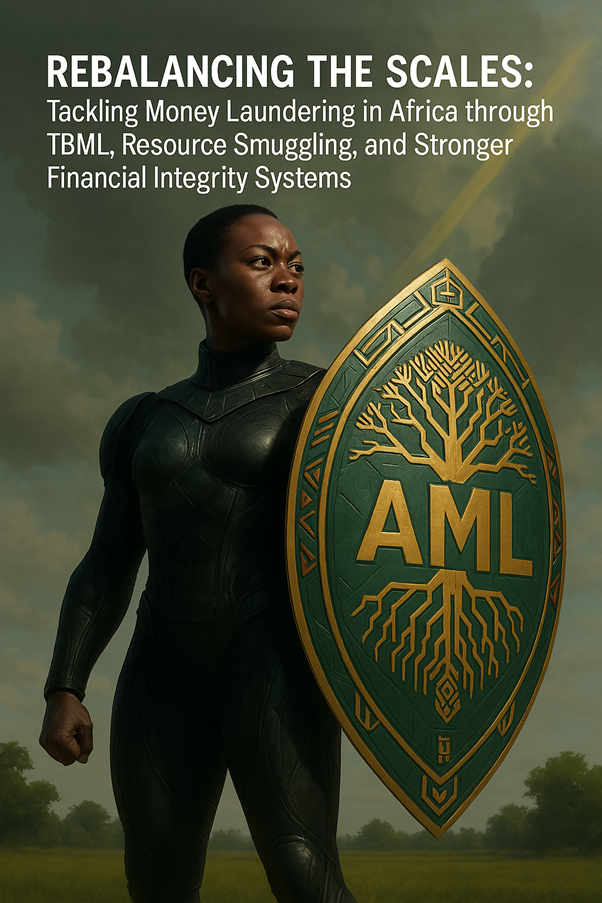
The architecture exists—but like an untested shield, it can shatter on impact.
AI and Technology: Africa’s AML Force Multiplier
Artificial Intelligence (AI) is fast becoming the most promising weapon in the fight against financial crime. As highlighted in the presentation:
Natural Language Processing (NLP) and Predictive Analytics can map suspicious networks, trace hidden beneficial ownership, and flag unusual patterns in real time.
Synthetic Identity Detection tools can unmask fraudsters hiding behind forged biometrics or fake IDs.
AI-enhanced Due Diligence (EDD) offers localized risk scoring, improving decision-making in resource-constrained institutions.
However, technology is only as good as its implementation. Without skilled analysts, independent oversight, and shared regional data platforms, AI remains underutilized.
The Trust Deficit: Why Independent Audits Matter
Multiple case studies—from regional banks implicated in wildlife smuggling, to microfinance institutions discovering 43 red flags post-audit—reveal a painful truth: internal audits alone are not enough.
Independent compliance audits provide:
Fresh Eyes to catch blind spots.
Unbiased Truths free from internal politics.
By Abdullah Moses
Introduction: Africa’s AML Crossroads
Across Africa, the fight against money laundering is no longer a matter of legal compliance—it’s a continental survival strategy. The convergence of trade-based money laundering (TBML), resource smuggling (gold, diamonds, oil), organized crime, and weak financial integrity systems threatens not just national treasuries, but regional peace and development.
The current financial compliance architecture must be independently verified, digitally resilient, and continentally harmonized—because trust is the currency Africa cannot afford to devalue.
The Web of Illicit Flows: TBML, Gold, Diamond, and Oil Smuggling
Illicit financial flows in Africa are intricately tied to the continent’s vast natural wealth. Smugglers exploit informal markets and regulatory loopholes through:
Gold and Diamond Smuggling: Billions in precious metals and stones are smuggled out annually, often under-invoiced or disguised as legal exports. These resources are sold on global markets, bypassing national revenue systems.
Oil and Gas Smuggling: Oil theft, particularly in Nigeria’s Niger Delta, is a major source of illicit income for criminal networks and insurgents, facilitated by falsified shipping manifests and non-transparent transactions.
TBML (Trade-Based Money Laundering): Criminals manipulate trade invoices—overstating imports or understating exports—to disguise the origin of illicit funds. This method thrives in Africa’s fragmented customs and weak border systems.
Organized Crime and Threat Finance: Smuggler networks often intersect with terror groups, especially in trans-Saharan corridors, using illicit trade to fund operations.
Quantifying the Damage: National Losses
According to the presentation:
Africa loses over $50 billion annually to illicit financial flows.
Nigeria alone loses over $15 billion annually through under-invoicing of oil and cross-border TBML.
South Africa faces billions in lost revenue through gold smuggling and synthetic identity fraud.
DRC, Mali, and Ghana are targeted for illegal mining, with gold exports heavily underreported or diverted to tax havens.
Kenya and Tanzania struggle with wildlife and counterfeit trade linked to laundering operations.
These figures represent more than lost taxes—they are stolen futures: in hospitals not built, schools not funded, and infrastructure left undone.
Cracks in the Shield: Africa’s Financial Integrity Architecture
While African states have adopted the FATF framework, regional AML/CFT strategies, and Mutual Legal Treaties (MLTs), the systems often fail at the point of enforcement:
Fragmented Oversight: Many national Financial Intelligence Units (FIUs) lack independence or capacity.
Political Interference: Investigations are sometimes blocked for political reasons.
Outdated Tools: Manual systems, Excel-based logs, and check-the-box audits are insufficient in a digital economy.
Lack of Independent Audits: Many institutions never undergo third-party testing, flying blind in a regulatory fog.
The architecture exists—but like an untested shield, it can shatter on impact.
AI and Technology: Africa’s AML Force Multiplier
Artificial Intelligence (AI) is fast becoming the most promising weapon in the fight against financial crime. As highlighted in the presentation:
Natural Language Processing (NLP) and Predictive Analytics can map suspicious networks, trace hidden beneficial ownership, and flag unusual patterns in real time.
Synthetic Identity Detection tools can unmask fraudsters hiding behind forged biometrics or fake IDs.
AI-enhanced Due Diligence (EDD) offers localized risk scoring, improving decision-making in resource-constrained institutions.
However, technology is only as good as its implementation. Without skilled analysts, independent oversight, and shared regional data platforms, AI remains underutilized.
The Trust Deficit: Why Independent Audits Matter
Multiple case studies—from regional banks implicated in wildlife smuggling, to microfinance institutions discovering 43 red flags post-audit—reveal a painful truth: internal audits alone are not enough.
Independent compliance audits provide:
Fresh Eyes to catch blind spots.
Unbiased Truths free from internal politics.